From planning to service: 3D roof measurement as a common thread in the PV project process



In this article, you'll learn how to create a 3D building model In all five project phases, uses what measurable effects this has on efficiency, error rate and legal certainty Has and how the Airteam Fusion platform supports you.
Why 3D roof measurement is becoming a continuous process basis for solar engineers
The PV market remains under high pressure: In 2024 alone, around 1.1 million new photovoltaic systems with an additional output of around 16.2 GW were connected to the grid in Germany[1] - Solar power thus covers around one seventh of German consumption.[2]
For solar engineers, this means:
- More inquiries in a short time
- Increasing price pressure and growing customer demands
- More complex roof geometries and mixed portfolios (existing, commercial, WEGs)
Traditional measurement methods are a bottleneck: Manual roof measurement typically takes 2-4 hours per building, and even longer for complex roofs. In Germany, over 20,000 ladder accidents are registered, a relevant proportion in the construction and roof sector. Measurement errors of 5-10% lead to rework, incorrect material ordering and loss of margins.
Digital drone measurement starts here: With the Airteam Fusion platform, you save up to 90% time, as a drone flight takes just a few minutes and the 3D model is ready within 24 hours. Depending on drone technology, the accuracy is up to 99.9% with a tolerance of only 1-3 cm at a height of 40 m and meets DIN SPEC 5452-5.
The decisive factor is how long you use the result. This is precisely the sustainable added value of 3D roof measurement.
Five phases of the PV process chain — one roof model
Solar projects can be divided into five phases:
- Bidding phase
- Project preparation
- Construction phase
- Acceptance & billing
- Maintenance & inspection
With a single AI-powered 3D building model You benefit in each of these phases.
1st offer phase: faster, more precise, more convincing
Your order is decided during the offer phase — speed and data quality count here.
Advantages of 3D roof measurement:
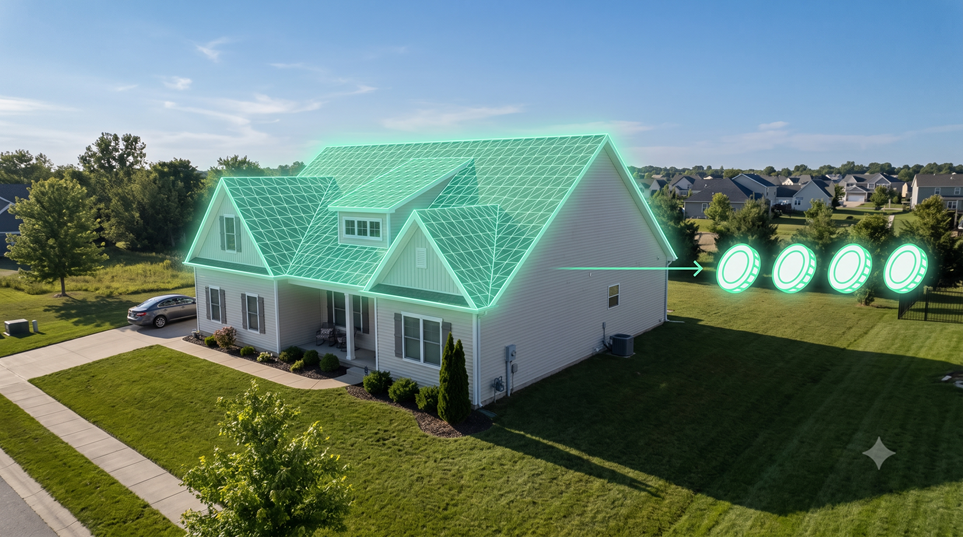
- Quick, precise measurements: A drone flight is enough. Airteam AI automatically recognizes all roof structures such as roof surfaces, dormers, throats or chimneys and creates a complete model.
- Complete recording of all structures: Complex roofs with extensions or penetrations are completely documented.
- Reputable calculation basis: You work with DIN-compliant dimensions and angles.
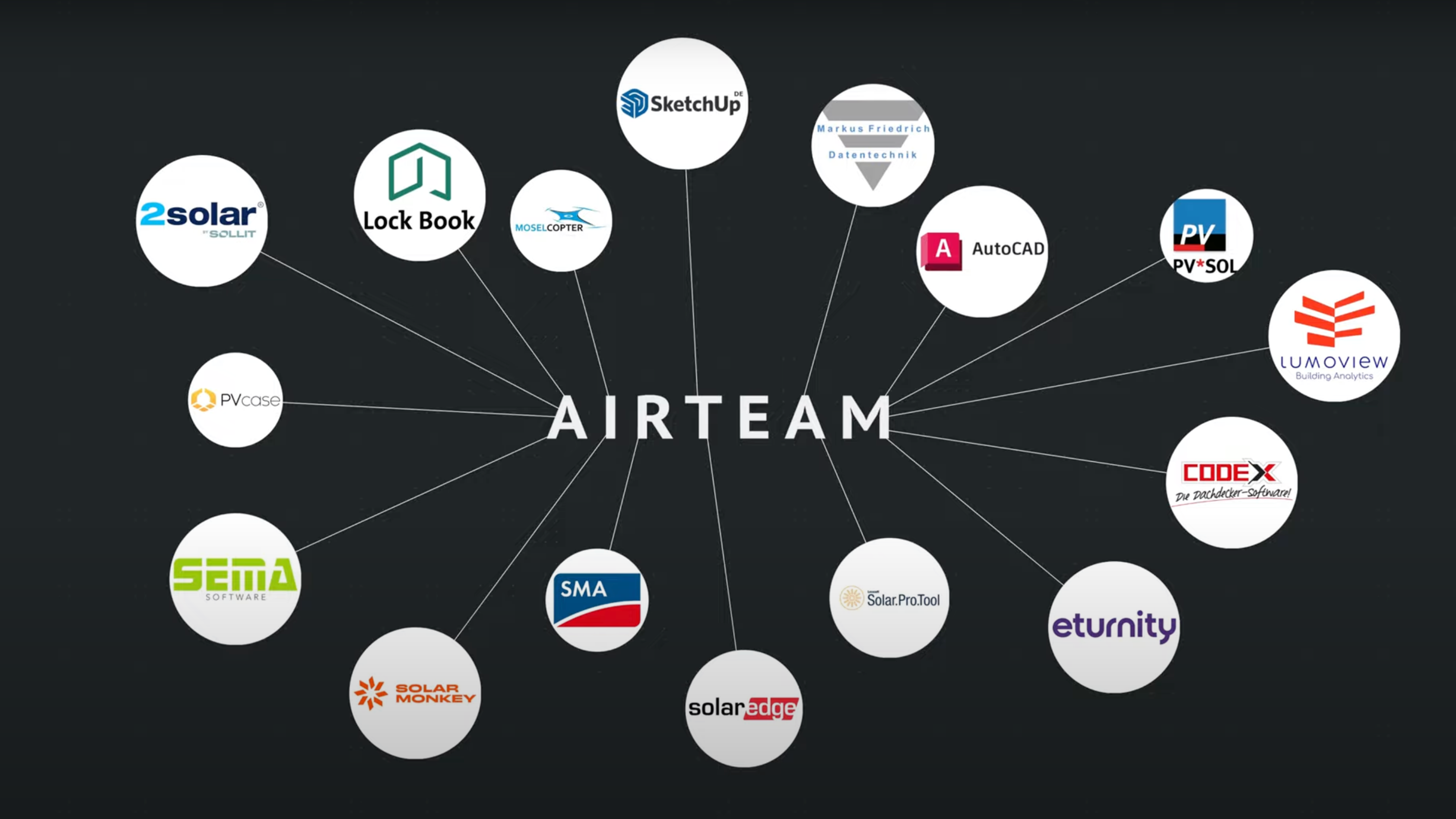
- Direct export to PV planning software: Data export to over 21 formats, direct integration e.g. in PV*SOL, Eturnity, SolarEdge Design or PVCase.
Result: You send offers earlier, document professionally and convince customers with comprehensible information.
2. Project preparation: better coordination, less buffers
After receipt of the order, preparation is decisive for smooth processes on the construction site.
Using the model in preparation:
- Ordering materials: Exact areas, inclinations and distances enable targeted quantity ordering, fewer incorrect orders.
- Scaffolding & logistics: Scaffolders receive reports with exact heights and dimensions, often without their own on-site appointment. Crane positions and storage areas can be planned using panoramas and orthophotos.
- Planning with architects & specialist planners: CAD data instead of sketches; changes are documented directly in the model.
Airteam provides you with standard-compliant reports and the appropriate export formats - from MF roof export to Scaffmax data.
3rd construction phase: everyone works with the same data
Large monitors in the warehouse and meeting room ensure that the 3D model unfolds its value.
Your advantage during the construction phase:
- Visualization on a 3D model: Fitters can see the real roof with all the details even before the appointment.
- Fewer inquiries: Many questions are answered directly on the model, telephone calls and additional trips are reduced.
- Efficient collaboration: Electricians, scaffolders and roofers access the same, reliable data.
Experience from Airteam projects shows: This is how solar engineers reduce planning times, optimize module design and increase economic success.
4. Acceptance & billing: legal certainty through documentation
Documentation is decisive in the event of acceptance, VOB billing or disputes.
Benefits of drone detection:
- Documented board: High-resolution images and 3D data confirm the status before the start.
- Objectivity in case of complaints: Damage or shading can be clearly proven.
- Second measurement for acceptance: Another drone flight provides clean final documentation.
Especially with larger or shared objects, this transparency ensures you fewer disputes and strengthens your position.
5. Maintenance & inspection: sustainable service
With a digital “roof twin”, you are launching a future-proof service area.
Here's how to use the model for maintenance:
- Portfolio recording: Several roofs can be flown off in one day.
- Analysis in the office: You can evaluate critical areas directly on the model.
- Targeted prioritization: You immediately recognize what is urgent — and what can wait.
This means fewer on-site appointments, targeted maintenance offers and predictable service growth.
Economic effect: sustainable ROI through one-time measurement
Many companies still see drone monitoring as a “special cost” for offers. In fact, once created, a 3D model pays off significantly faster across the entire process chain.
With Airteam, over 5,000 companies have already implemented over 70,000 projects using drone and AI measurement. The pattern is clear:
- Fewer trips (initial measurement and rework)
- Stable supply margins through exact quantities
- Fewer discussions during acceptance and warranty
- Scalable processes - especially for series projects or large portfolios
Comparison: classic measurement vs. 3D roof model with Airteam
PhaseClassic procedure3D roof measurement with AirteamDirect benefit for you Offer phaseOn-site appointment, manager, manual measurementDrone flight, automatic 3D modelFaster offer, higher quotation qualityProject preparationMultiple appointments with scaffolding/architectDigital reports & CAD exports from one modelLess coordination effort construction phase sketches, different information levelsCommon view of the 3D modelFewer inquiries & additional trips acceptance & billing Photos, notes, manual list before/after drone recordings + structured reportsHigher legal certainty, clear evidenceMaintenance & inspectionIndividual appointments on the roofPeriodic drone flights, evaluation in the officeScalable maintenance, predictable service revenues
Integration of 3D roof measurement along the process chain
To ensure that the 3D model does not remain in the offer folder, a structured approach is recommended:
1. Clear definition: When does measurement start?
Define project size or customer types for which drone measurements are standard - e.g. from 10 kWp, for commercial projects or routes.
2. Clarify roles and responsibilities
Determine who flies, who creates the project in the Airteam Fusion platform and who exports which data. A short checklist is often sufficient.
3. Use interfaces consistently
Integrate the model with existing tools:
- PV planning: import into PV*SOL, Eturnity, etc.
- Calculation: Transfer of quantities to quotation software (e.g. MF Dach)
- Scaffolding and timber construction: export to Scaffmax, SEMA & Co.
In this way, you avoid media breaks and the manual transfer of data.
4. Combine flat rates and credits
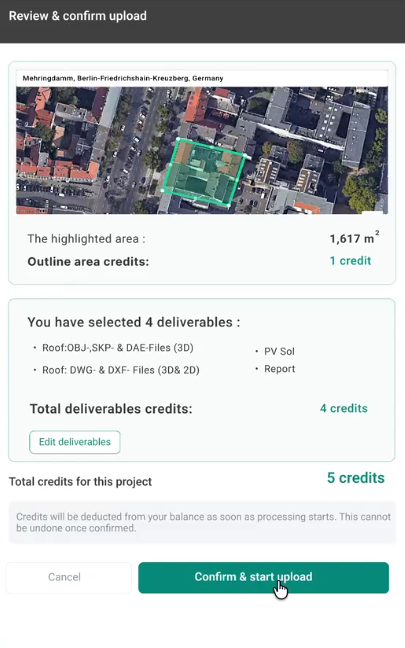
With Airteam flat rates (Fast, Pro, Max, Ultra Fusion) cover common project sizes. You can use credits flexibly for large roofs or additional data - without involving new providers or tools.
5. Adapt communication to the outside world
Actively use the “digital measurement” in sales: Show 3D visualizations, explain precise, DIN-compliant planning and offer optional maintenance packages based on the digital roof twin.
Conclusion: From one-time measurement to digital roof twin
Drone measurement is more than just a modern replacement for the tape measure. Used correctly, is this 3D building model the common thread of your PV process chain — from initial quotation calculation to recurring maintenance.
You benefit from:
- Time gain - same, complete data in all phases
- surety - Protection on construction sites and legally compliant documentation
- precision - technically and economically optimal systems
- predictability - through scalable, clearly documented workflows
If you establish 3D roof measurement not only as an offer tool, but as a process basis, every drone flight becomes a sustainable investment in efficiency and competitiveness.
Frequently Asked Questions
Will a 3D roof measure also benefit me if the customer does not accept the offer?
Yes — especially for recurring customer types or existing objects. The model remains stored in your Airteam Fusion platform and can be used directly for later requests (e.g. system expansion, storage, roof renovation). For building stocks, the model builds up a database for future projects.
Is a drone flight really enough for all project phases?
In most cases, yes. A carefully planned flight provides all relevant data for the offer, preparation, construction and billing. For maintenance and inspection, it is advisable to carry out further flights at longer intervals in order to document changes such as damage. The initial flight remains the central data basis.
How complex is it to get started with drone and AI-based measurement?
Getting started is easier than often thought. Airteam provides starter sets including drone, training and support, plus cloud software that can be used without CAD knowledge. Clear internal processes are crucial: Who flies, who creates projects, who exports data. Many companies have adapted their team to the standard process within a few weeks.
How secure and legally secure is the data?
Due to compliance with DIN SPEC 5452-5 and high geometric accuracy, Airteam data is suitable for VOB-compliant billing and technical evidence. Supplemented by image documentation, you will receive reliable evidence in the event of disputes. It is important to archive the data on a project-specific basis and to document it comprehensibly.
Is 3D roof measurement also worthwhile for small roofs and single-family homes?
Yes - this is where time savings and higher safety have an effect. Instead of 2-4 hours of measurement time, you do the measurement in just a few minutes and send the offer faster. The effect is particularly great when there is a high volume of inquiries. With flat rates such as Fast or Pro Fusion, even small projects can be implemented economically; for larger projects, you can use credits flexibly.