What You Should Consider Before and After Solar Planning with Airteam


Incorrect roof measurements, miscalculated material requirements, forgotten system registration – most problems in PV projects don't arise on the roof, but before and after. Approaching solar planning systematically saves time and costs, and avoids expensive rework.
This checklist concisely shows you which steps are truly crucial before solar planning – and what you must not forget after installation. With the Airteam Fusion Platform you can cover the most complex part entirely digitally: precise roof measurement.
Before Solar Planning: These Points Are Crucial
Many errors in PV projects originate in the preparation phase. Inaccurate measurements, overlooked shading, or missing structural integrity checks ultimately cost more time and money than careful planning. With structured preparation, you lay the groundwork for a successful solar project.
1. Realistically Assess Roof Suitability
Not every roof is equally suitable for a photovoltaic system. A south-facing orientation and a pitch of 30 to 40 degrees are optimal for maximum electricity yields. However, it's not just south-facing roofs that are suitable: unshaded roof areas from west to east are also suitable for a PV system.
Also crucial: pitched roofs are ideal, while flat roofs often require a structural assessment and, if necessary, additional weights for wind resistance. For a PV system, an additional roof load of at least 25 kg/m² is considered – the roof's structural integrity must be able to bear this.
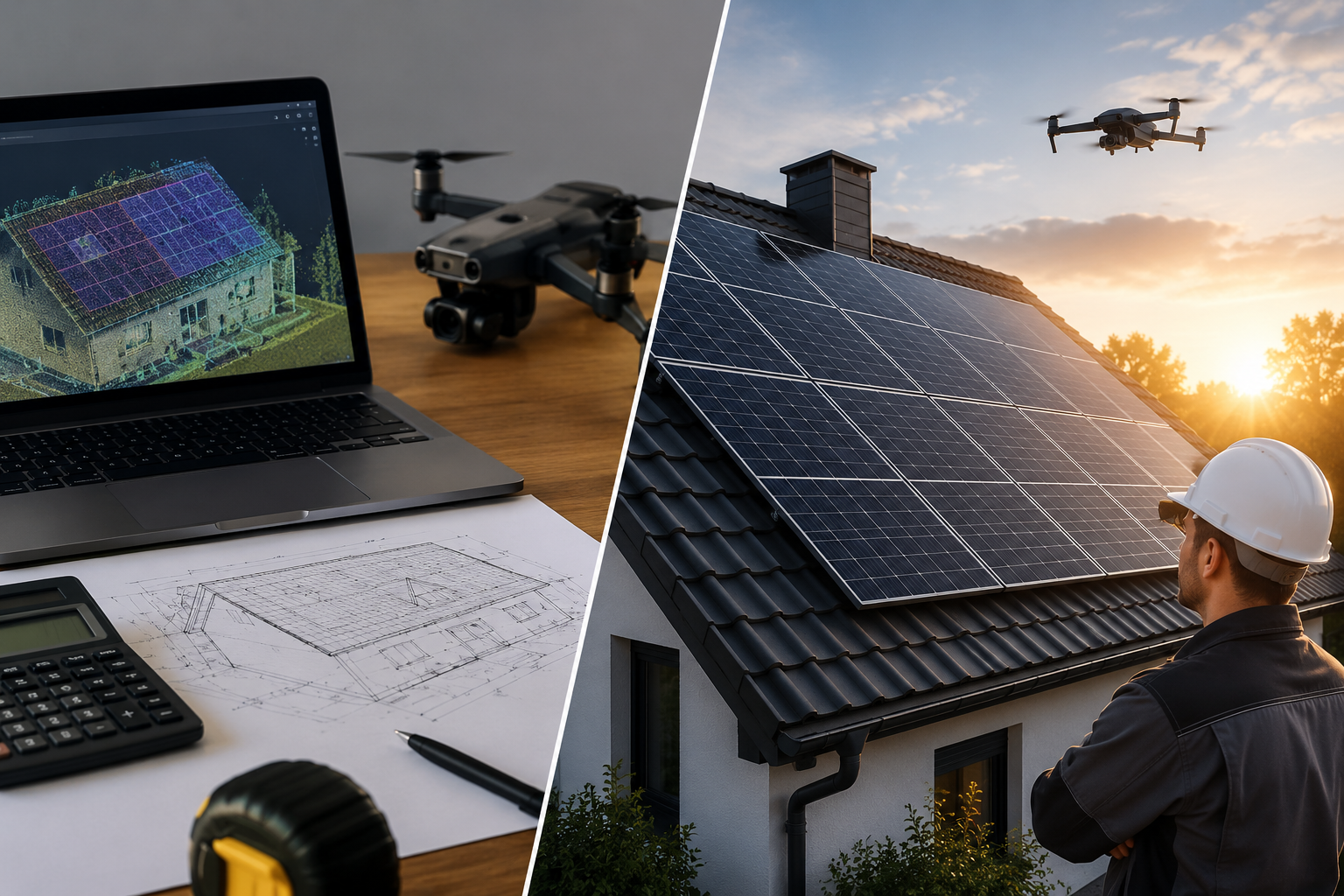
Instead of risky roof inspections: With a drone flight and the Airteam Fusion Platform, you can fully capture roof pitch, orientation, structures, and shading sources from the ground – precisely, safely, and in less than 24 hours.
2. Precise Roof Measurement as a Planning Basis
The measurement is the core of any solar planning. Those who work with estimates or inaccurate data risk miscalculations in material requirements, incorrectly sized module arrays, and costly reorders.
The Airteam Fusion Platform provides AI-supported 3D building models with DIN-certified accuracy of up to 99.9% and a tolerance of only 1-3 cm at 40 m flight altitude – significantly more precise than conventional methods and up to 90% faster than traditional manual measurements.
3. Seamlessly Integrate Data into PV Software
A good measurement only unfolds its full value when the data flows smoothly into the planning software. The Airteam Fusion Platform exports measurement data in over 15 formats – compatible with PV*SOL, Eturnity, SolarEdge Designer, AutoCAD, and many other tools. This eliminates any manual data entry.
4. Keep Subsidies and Grid Operators in Mind
If financial subsidies for the PV system are to be claimed, for example, a KfW promotional loan, these must be applied for and approved before the order is placed with the installation company. Since 2023, PV systems and battery storage units have been exempt from VAT – significantly reducing acquisition costs.
Furthermore: In many federal states, there is now a solar obligation for roof renovations. You should clarify this point with the customer early on.
After Installation: These Points You Must Not Forget
The work doesn't end with the last bolted rail. Those who proceed systematically after installation protect themselves from legal loopholes, secure feed-in tariffs, and create the basis for long-term customer loyalty.
5. Conclude Documentation and Acceptance Legally Securely
A complete and reputable offer should generally include the following points: system technology, assembly and installation work, cost breakdown, general contract conditions, and the solar installer's services after installation. These documents are indispensable for the customer even after installation – and absolutely necessary for commissioning with the grid operator.
All relevant project data – 3D models, reports, and measurement data – are centrally stored and shareable at any time on the Airteam Fusion Platform. This way, you always have access to complete project documentation.
6. Register the System and Set Up Monitoring
After commissioning, the system must be registered in the Market Master Data Register (MaStR) – this is a legal requirement for feed-in tariffs. In the first year, the feed-in tariff applies from commissioning until the end of the year, and then for another 20 full calendar years.
Equally important: Instruct the customer on how to use the monitoring system so they can keep track of yields and any potential malfunctions themselves.
7. Offer Regular Drone Inspections as a Service
A PV system that is not maintained loses yield over time. Hotspots, soiling, or storm damage can be detected early and safely from the ground with a thermal drone inspection – entirely without scaffolding or ladders.
This is not only added value for the customer but also an attractive additional service for your business.
Why Precise Measurement is the Most Important Lever
Most points on both checklists directly depend on the quality of the initial data. Inaccurate measurements run like a common thread through the entire project – from miscalculations in the quote to costly corrections on the construction site.
With Airteam, you start every solar project with a reliable, DIN-compliant data basis. This saves time, protects against errors, and makes your offer more professional and convincing. Successful solar installers like Solit Energie AG are already relying on this method – with measurable results.